

A turnaround is one of the most expensive events an oil and gas facility runs.
Thousands of work orders. Hundreds of contractors who have never set foot in the facility before. Critical rotating equipment that has not been touched since the last major shutdown. Every hour over schedule costs money. Every wrong part ordered costs time.
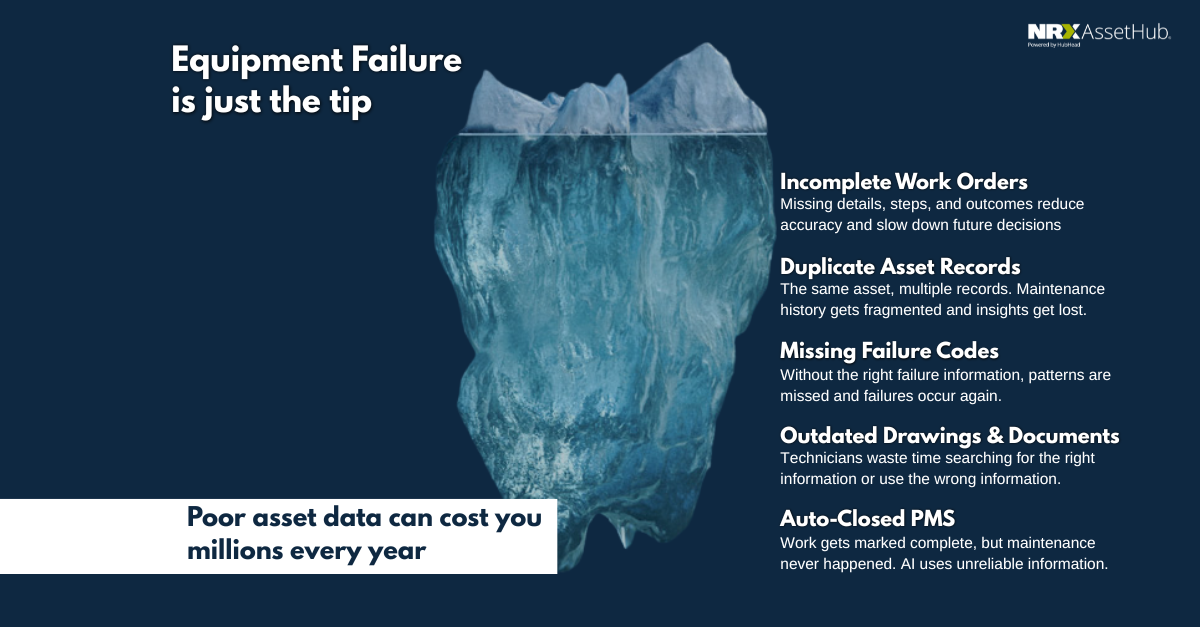
And underneath all of it, the same data problems that exist every other day of the year.
P&IDs updated by hand during the last turnaround but never digitized. OEM manuals for compressors and pumps that exist as scanned PDFs nobody can search. Spare parts data spread across supplier invoices, vendor catalogs, and someone’s spreadsheet. Asset hierarchies that differ across sites because each facility was acquired or built at a different time under different standards.
Oil and gas operations are among the most complex, most document-heavy, and most high-stakes asset management environments in any industry. Whether your team runs IBM Maximo, SAP, AVEVA, or Infor, that complexity makes the cost of bad data higher here than almost anywhere else.
In oil and gas, the data problem is not new. But the cost of leaving it unaddressed keeps growing every turnaround.
How Poor Asset Data Quality Slows Oil and Gas Turnarounds
Every turnaround starts with a planning phase. Work packages get built. Contractors get briefed. Parts get ordered. Inspection scopes get defined.
Every one of those activities depends on accurate asset data.
When the OEM manual for a critical compressor exists only as a scanned PDF, the planner building the work package has to find it, open it, and manually extract the specs they need. When nameplate data for a pump was never entered into the EAM, the contractor on site has to locate the physical nameplate to confirm the rating before they can proceed. When P&IDs from the last turnaround have redlines that were never digitized, the reliability engineer reviewing the modification scope is working from a version of the plant that no longer exists.
Each of these delays is small on its own. Across a turnaround involving hundreds of assets and dozens of contractors, they add up to significant overruns.
For organizations running IBM Maximo or SAP as their EAM, the data quality issues compound further because these systems depend entirely on what was entered into them. If the records are incomplete, inconsistent, or outdated, even the most sophisticated EAM platform cannot produce reliable outputs.
Why Asset Data Quality Is Critical for Multi-Site Oil and Gas Operations
For oil and gas organizations operating across multiple facilities, the data problem compounds further.
Each site may have its own asset hierarchy, its own tag naming conventions, its own way of recording maintenance history and failure codes. When those standards differ, it becomes impossible to compare reliability performance across facilities, identify recurring failure patterns at the enterprise level, or make confident decisions about where maintenance investment is most needed.
Which facilities are experiencing the most unplanned downtime? Which spare parts are being duplicated across sites at significant cost? Which assets are approaching end of life across the portfolio?
These are the questions enterprise reliability leaders need to answer. In most multi-site oil and gas operations, the data to answer them confidently does not exist in a single, trusted, comparable format.
When reliability data cannot be compared across sites, enterprise decisions get made on incomplete information.
How to Improve Asset Data Quality for Oil and Gas Operations
The oil and gas organizations reducing turnaround overruns, improving reliability, and getting more value from their EAM and CMMS investments are not necessarily running the most advanced technology. They are running the most reliable data.
For document-heavy environments like oil and gas, that means getting critical asset information out of scanned PDFs and into structured, searchable, EAM-connected formats. NRX Extractor does this automatically, extracting data from OEM manuals, supplier invoices, equipment nameplates, P&IDs, and estimates without manual re-entry, and pushing clean structured data directly into IBM Maximo, SAP, AVEVA, Infor, and other systems.
For turnaround efficiency, it means giving maintenance teams and contractors instant access to complete, accurate asset information from any device. NRX Twin Builder builds digital twins automatically from OEM manuals so technicians can find the right spare part and submit a parts request before they reach the equipment, whether they are at a desk or on the plant floor at 2am during a turnaround.
And for multi-site operations, it means establishing the data standards that make enterprise reliability decisions possible. Asset hierarchy rules, tag naming conventions, and a shared data dictionary that engineering, maintenance, and IT all work from, consistently, across every facility in the portfolio.
Preparing for Your Next Oil and Gas Turnaround with Better Asset Data
How much of your last turnaround overrun was caused by technology problems?
And how much was caused by contractors waiting for information, planners re-entering data that already existed somewhere, or reliability engineers working from drawings that did not reflect the current state of the plant?
In oil and gas, the margin for error is too small and the stakes are too high to run on asset data that cannot be trusted. Whether your operation runs on IBM Maximo, SAP, AVEVA, or another EAM platform, the data going into that system determines the value coming out of it.
What would your next turnaround look like if every piece of information your team needed was already where they needed it?
NRX AssetHub helps oil and gas organizations clean, structure, and trust their asset data so every turnaround runs more efficiently and every reliability decision is made on complete information. Ready to see what NRX can do for your operation? Book a free demo with our team.
Related Posts

Share this article


