
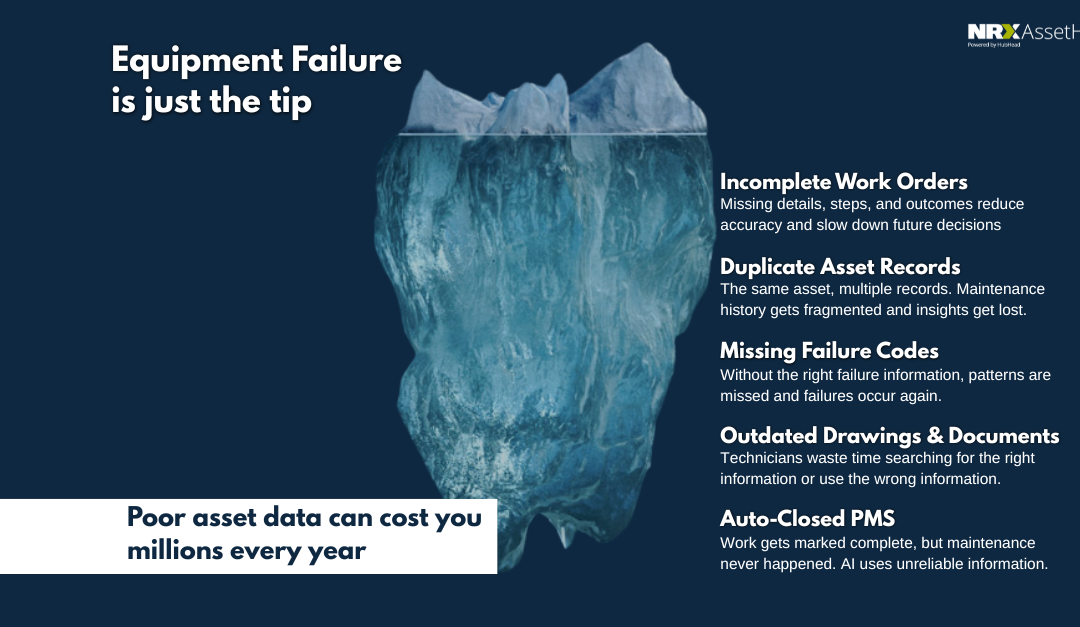
The hidden costs of poor asset data that never show up in your downtime reports
According to Oxford Economics and Splunk, the average Global 2000 company loses nearly $200 million annually to unplanned downtime. For most organizations, that figure immediately brings to mind production losses, emergency maintenance, and equipment failures.
Those costs are significant, but they only tell part of the story.
Many of the expenses associated with unplanned downtime begin long before equipment fails. They develop gradually through incomplete work orders, inconsistent asset records, outdated engineering information, and poor data governance. Individually, these issues may appear insignificant.
Collectively, they reduce maintenance efficiency, limit operational visibility, and weaken every technology that depends on accurate asset data.
Understanding these hidden costs is essential for organizations looking to improve reliability and maximize the value of their CMMS and EAM investments.
1. Downtime Often Starts Before the Repair Begins
When equipment fails, the repair rarely starts immediately.
A technician may first need to locate the correct engineering drawing, verify the asset record, review previous maintenance history, or determine which version of the information is accurate.
In many organizations, these activities are still performed manually because information is scattered across PDFs, engineering drawings, spreadsheets, and disconnected systems.
Although this time is rarely captured in downtime reports, it represents a significant operational cost. Every minute spent searching for information is a minute not spent diagnosing or repairing the asset. Across multiple technicians, shifts, and facilities, those delays accumulate into thousands of lost maintenance hours each year.
2. Poor Data Reduces Confidence in the CMMS
A CMMS is only valuable if maintenance teams trust the information it contains.
When work orders are incomplete, preventive maintenance activities are incorrectly recorded, or duplicate asset records exist, confidence in the system gradually declines. Rather than relying on the CMMS, planners and technicians begin checking spreadsheets, reviewing old emails, consulting experienced coworkers, or searching through engineering documents.
Once this happens, the organization begins operating outside the system it invested in. Data quality deteriorates further, reporting becomes less reliable, and maintenance planning becomes increasingly reactive.
3. Every Technology Investment Depends on the Same Foundation
Organizations continue investing in predictive maintenance, AI, analytics, and Enterprise Asset Management (EAM) platforms to improve reliability and reduce downtime. These technologies can provide significant value, but they all rely on one critical input: accurate asset data.
Incomplete work histories, inconsistent failure codes, duplicate asset records, and outdated maintenance information limit the effectiveness of every system built on top of them. Rather than improving decision-making, advanced technologies often reinforce existing data quality issues by generating insights from unreliable information.
Technology can accelerate maintenance performance, but it cannot compensate for poor data quality.
4. The Organization Stops Learning From Failure
Perhaps the greatest hidden cost of poor asset data is the inability to learn from previous failures.
Every completed work order represents an opportunity to improve future maintenance decisions. However, when failure codes are missing, root causes are poorly documented, or maintenance histories are incomplete, recurring problems become difficult to identify.
Instead of recognizing trends and preventing future failures, organizations repeatedly address the same issues without understanding why they continue to occur. As a result, downtime becomes cyclical rather than preventable.
Building a Stronger Data Foundation
Organizations that consistently improve reliability rarely begin with new technology. They begin by improving the quality of the information that supports every maintenance decision.
Standardized asset naming conventions, complete work order histories, accurate failure coding, and ongoing data governance create a reliable foundation for predictive maintenance, AI initiatives, and digital transformation programs. Without that foundation, even the most advanced software cannot deliver its full value.
Before investing in another platform, organizations should ask a simpler question:
Can we trust the data inside our CMMS today?
If the answer is uncertain, improving asset data quality may deliver greater operational value than the next technology investment.
Related Posts


Share this article


