

Oil and gas, utilities, mining, and manufacturing operate in very different environments. The equipment changes, the maintenance challenges change, and the consequences of downtime look different.
But across each industry, the same asset data problem continues to surface.
Critical information exists, but it is often incomplete, outdated, unstructured, or disconnected from the systems and people that need it.
In oil and gas, equipment specifications may be buried in OEM manuals or P&IDs. Utilities may rely on decades of documentation that has never been properly digitized. Mining operations may have nameplate information stored as photos instead of structured asset records. In manufacturing, years of work orders may exist without the failure codes and root causes needed to understand recurring equipment problems.
The information is there. The challenge is making it usable.
Why Asset Data Quality Problems Build Over Time
Poor asset data rarely comes from one major mistake. It develops through small gaps in everyday processes.
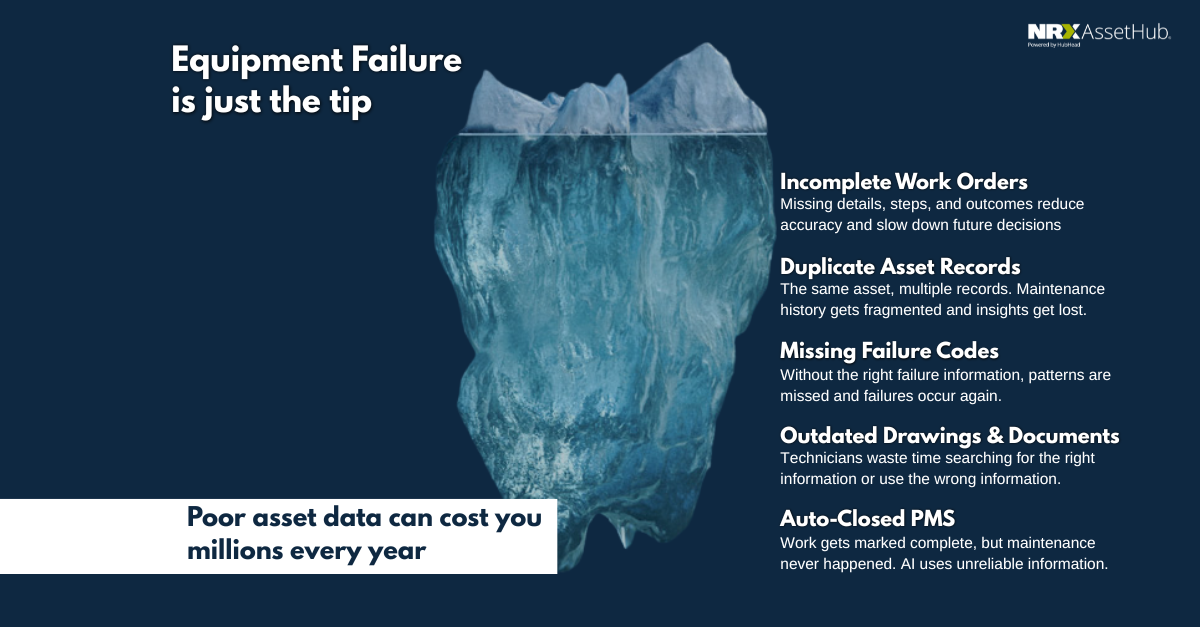
A nameplate gets photographed but never entered into the EAM. A work order gets closed without a failure code. A drawing is updated during a project, but the revision never reaches the asset record. An OEM manual is stored as a PDF without anyone extracting the equipment specifications inside it.
One missing field may not seem significant. Across thousands of assets, multiple facilities, and years of maintenance activity, those gaps add up.
The result can be duplicate records, inconsistent asset hierarchies, outdated spare parts information, incomplete maintenance histories, and technical documentation that teams struggle to access when they need it.
How Poor Asset Data Affects Reliability
The impact becomes more visible when organizations begin relying on that information for maintenance and reliability decisions.
An EAM migration can move years of inconsistent records into a new platform without resolving them. Predictive maintenance tools may have incomplete maintenance histories to learn from. Maintenance teams can lose time confirming equipment specifications or locating the correct replacement part during a failure.
According to IFS, Fortune Global 500 companies experience an estimated $1.4 trillion in annual equipment downtime costs, roughly 11% of revenue.
Not all of that downtime is caused by poor asset data. But when equipment is already down, incomplete or inaccessible information can make recovery slower than it needs to be.
The repair may take an hour. Finding the correct manual, confirming what is installed in the field, or identifying the right spare part can add unnecessary time before that repair even begins.
Building a Better Asset Data Foundation
Improving asset data does not always mean collecting more information. Often, organizations already have much of what they need.
The challenge is turning information from OEM manuals, engineering drawings, nameplates, supplier documentation, maintenance histories, and existing EAM records into structured and connected asset data.
NRX addresses different parts of that process.
NRX Extractor turns information from existing documentation into structured asset data.
NRX Twin Builder organizes OEM information into digital twins that connect equipment with components, specifications, and spare parts.
NRX AssetHub helps organizations analyze, repair, and sustain CMMS and EAM data so those records remain complete and consistent over time.
The goal is not simply cleaner data. It is information that maintenance teams, reliability leaders, EAM platforms, and emerging technologies can actually use.
Better Asset Management Starts With Better Data
The operational challenges may look different across oil and gas, utilities, mining, and manufacturing, but the underlying requirement remains the same.
Asset information needs to be complete, accurate, structured, and accessible.
As organizations invest in EAM platforms, predictive maintenance, digital twins, and industrial AI, the quality of the data underneath those investments becomes increasingly important.
Before adding another layer of technology, there is one question worth asking:
Can the people and systems making critical decisions trust the asset data they already have?
NRX AssetHub helps asset-intensive organizations analyze, repair, and sustain CMMS and EAM data to build a stronger foundation for maintenance and reliability.
Related Posts

Share this article


