
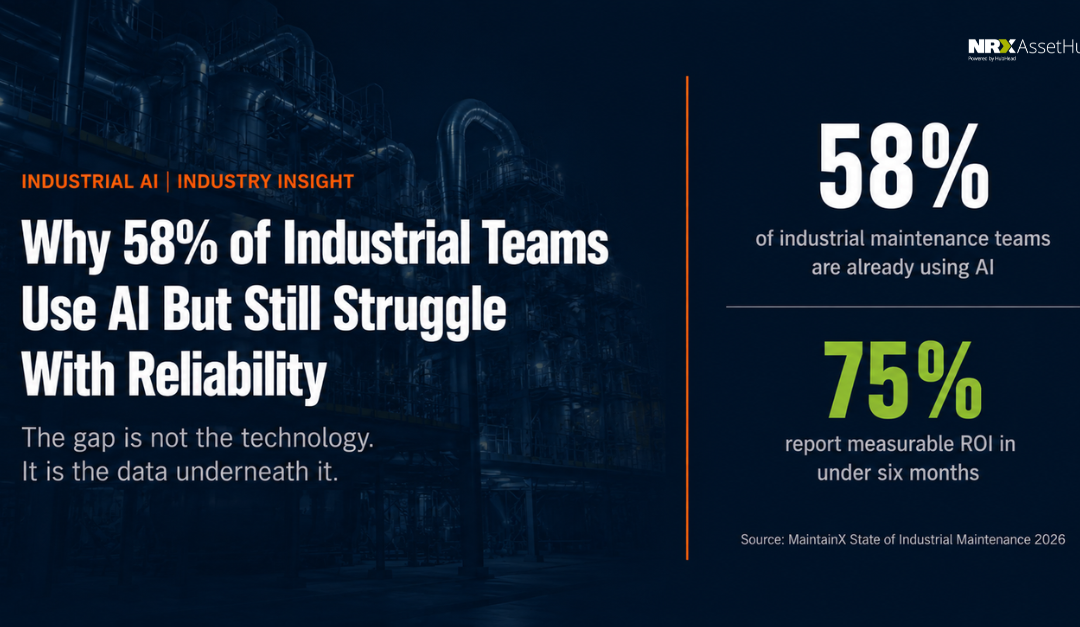
According to the MaintainX State of Industrial Maintenance Report 2026, 58% of industrial maintenance teams are already using AI in their operations. 75% report measurable ROI in under six months.
Those are remarkable numbers. So why does the same report find that most organizations are still struggling to improve asset reliability despite broader adoption of AI and digital technologies?
The answer is not a technology problem. It is a data problem.
Reliability gains come from execution maturity, not system adoption alone. The organizations getting real results are combining modern tools with strong fundamentals.
The gap between Industrial AI adoption and Real value
Most industrial AI tools are genuinely powerful. Predictive maintenance platforms that identify failure patterns weeks in advance. Condition monitoring systems that detect anomalies before they become breakdowns. Reliability analytics that surface insights no human analyst could find in the same timeframe.
But every one of those tools depends on one input above everything else: clean, structured, trusted asset data.
When AI learns from duplicate asset records, it learns fragmented patterns. When it trains on incomplete maintenance histories, it builds an inaccurate picture of asset health. When it ingests OEM manuals that were never properly digitized, it cannot access the equipment specifications it needs to make reliable recommendations.
The AI tool performs exactly as designed. The data it was given determines whether the output is useful or not.
Two organizations. Same AI tool. Different outcomes.
Organization A invests in a predictive maintenance platform. The tool goes live and starts flagging anomalies. The maintenance team investigates. Half the alerts lead nowhere because the asset records feeding the model are incomplete. Trust in the system drops. Within six months the team has gone back to reactive maintenance.
Organization B makes the same investment. But before go-live, they spend time cleaning their CMMS data. Standardizing asset hierarchies. Completing maintenance histories. Enforcing failure code compliance. Getting OEM documentation out of scanned PDFs and into structured, EAM-connected formats.
The predictive maintenance tool generates the same type of alerts. But now the maintenance team trusts them. Because the data behind each alert is accurate. The asset record is complete. The history is real.
Same technology. Completely different outcome.
The AI tools available to industrial maintenance teams today are genuinely powerful. They are only as powerful as the data foundation they run on.
Why Industrial AI depends on Asset Data Quality
Building a data foundation that industrial AI can reliably learn from requires addressing several layers of the asset data problem.
First, critical asset information needs to get out of unstructured documents and into the EAM in a usable format. OEM manuals, supplier invoices, equipment nameplates, P&IDs, and engineering drawings all contain data that AI needs but cannot access when it is trapped in scanned PDFs and unindexed folders. NRX Extractor addresses this automatically, extracting and structuring document data without manual re-entry.
Second, maintenance teams need accurate, accessible asset information at the moment they need it, not after they have spent 40 minutes searching for a torque spec or a part number. NRX Twin Builder builds complete digital twins from OEM manuals automatically, so the right information is available from any device including mobile on the plant floor.
Third, for multi-site organizations, the data standards that make AI results comparable across facilities need to be established before AI tools go live. Asset hierarchy rules, tag naming conventions, and a shared data dictionary that engineering, maintenance, and IT all work from consistently.
The Future of Industrial AI Starts With Better Data
More than two thirds of maintenance teams plan to adopt AI by end of 2026. That is a significant wave of investment coming into asset-intensive industries across oil and gas, utilities, mining, and manufacturing.
The organizations that will get the most from that investment are not necessarily the ones who move fastest on technology adoption. They are the ones who ask the data question first.
Is our asset data clean enough for AI to learn from? Are our OEM documents structured and accessible? Do our asset hierarchies match the physical plant? Can we compare reliability data across sites?
If the answer to any of those questions is uncertain, the data conversation needs to happen before the AI budget gets approved, not after the tool is live and the ROI is not showing up.
What would your AI initiatives deliver if the data behind them could be fully trusted?
NRX AssetHub helps asset-intensive organizations analyze, repair, and sustain CMMS and EAM data so every AI and technology investment built on top of it can deliver maximum value. Ready to build the foundation your AI initiatives need? Book a free demo with our team.
Source: MaintainX State of Industrial Maintenance Report 2026. MRO Magazine, May 2026.
Related Posts


Share this article


