
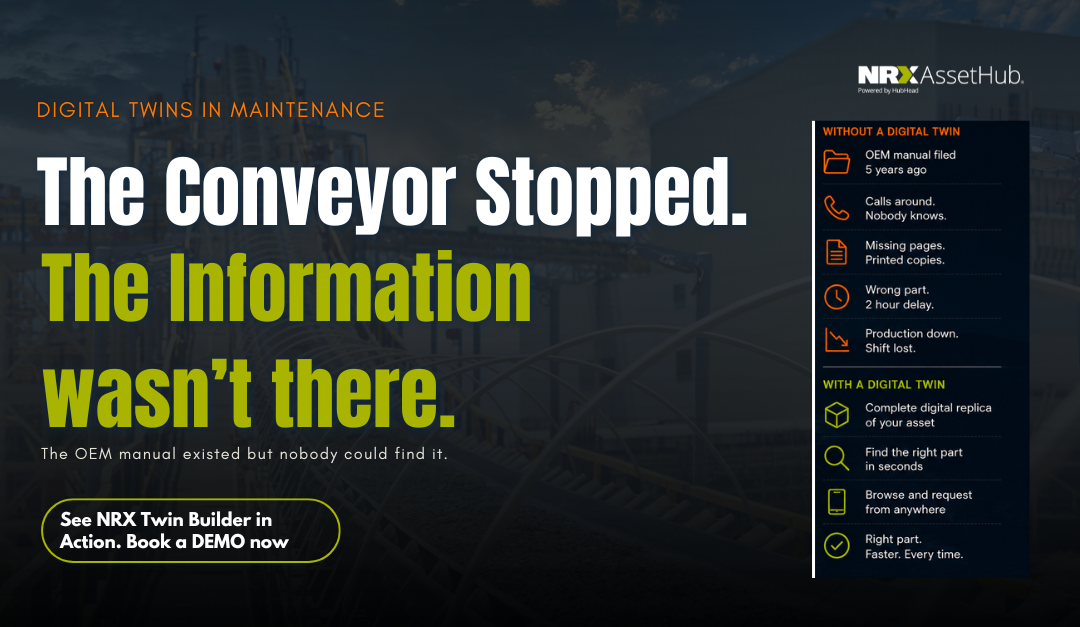
A conveyor shuts down mid-shift at a mining facility.
The maintenance planner gets the call. They need the component specs, the correct replacement part, and confirmation that it is in stock. They open the EAM. The record references an OEM manual that was filed during commissioning five years ago. Nobody knows which folder it is in.
The shift supervisor calls around. Someone finds a printed copy in the maintenance office with half the pages missing.
Two hours later the right part is identified. The order goes in but the production is down for the rest of the shift waiting for it to arrive.
The information existed. It just was not where anyone could use it when it mattered.
This is the problem digital twins were built to solve. And it is the same problem most digital twin initiatives fail to fix.
The technology is not the barrier. The data foundation is.
What are digital twins?
A digital twin is not a 3D model. It is not a dashboard.
It is a complete digital replica of a physical asset. Every component. Every spare part. Every spec. Every OEM manual. Linked together and accessible the moment a maintenance team needs it.
When it works, a technician navigates to any asset in the hierarchy, sees exactly what it is made of, identifies the correct replacement part visually, and submits a parts request from their phone before they reach the plant floor.
The right part. First time. Every time. MTTR drops. Procurement costs go down. Work orders contain more accurate information. Planning becomes more efficient.
The business case is clear. So why do most digital twin initiatives fail to deliver it?
Why Digital Twin Projects in Maintenance Fail?
Most digital twin initiatives stall at the same point: data preparation.
Building a complete digital twin manually means going through every OEM manual page by page. Extracting every component. Identifying every spare part. Linking everything to the correct asset in the EAM. For a single critical asset that process can take days. For a full facility it can take months.
Most organizations start. Few finish. And the ones that do finish often find the digital twin is already out of date because the plant changed during the time it took to build it.
The result is a digital twin that technicians do not trust, planners do not use, and leadership cannot justify continuing to invest in.
A digital twin built on incomplete data is not a digital twin. It is a digital liability.
How NRX Twin Builder Builds Digital Twins Automatically
NRX Twin Builder was built specifically to close this gap.
Instead of requiring someone to manually extract data from OEM manuals, NRX Twin Builder does it automatically using AI. Upload the documentation, and the system extracts every component, every spare part, every spec, and builds a complete digital twin linked to your asset hierarchy.
Drawings and models are hot-pointed and linked automatically. Technicians can browse equipment visually, select the exact part they need, and submit a parts request from any device including mobile on the plant floor.
The result is a digital twin that takes 90% less time to build and maintain than doing it manually. One that stays current as the plant changes. One that technicians actually use because the information is accurate and accessible when they need it.
And because NRX Twin Builder integrates with IBM Maximo, SAP, AVEVA, Infor, and other EAM and CMMS systems, the digital twin is part of the workflow maintenance teams already use, not a separate tool they have to remember to check.
How to Implement Digital Twins in Maintenance Successfully
The organizations that get the most value from digital twins start small and scale deliberately.
Begin with your highest-priority assets. The ones where a failure causes the most downtime or where finding the right spare part takes the longest. Build the digital twin for those assets first. Let your maintenance team use it on real work orders. Measure the impact on MTTR and parts accuracy.
Then scale to the next asset class. Building continuously rather than attempting a full facility rollout from day one.
The conveyor shutdown does not have to cost two hours of production time. With a complete, trusted digital twin built from your existing OEM documentation, the right part is identified and ordered before the technician reaches the floor.
NRX AssetHub helps asset-intensive organizations in oil and gas, utilities, mining, and manufacturing build and maintain digital twins automatically from OEM documentation. Ready to see NRX Twin Builder in action? Book a free demo with our team.
Related Posts

Share this article


